Shoe Depth Decoded: How Penetration Levels Tip the Scales in UK Blackjack Games
Nils Klein · May 15, 2026

Shoe Depth Decoded: How Penetration Levels Tip the Scales in UK Blackjack Games
Understanding Shoe Depth in Blackjack Basics
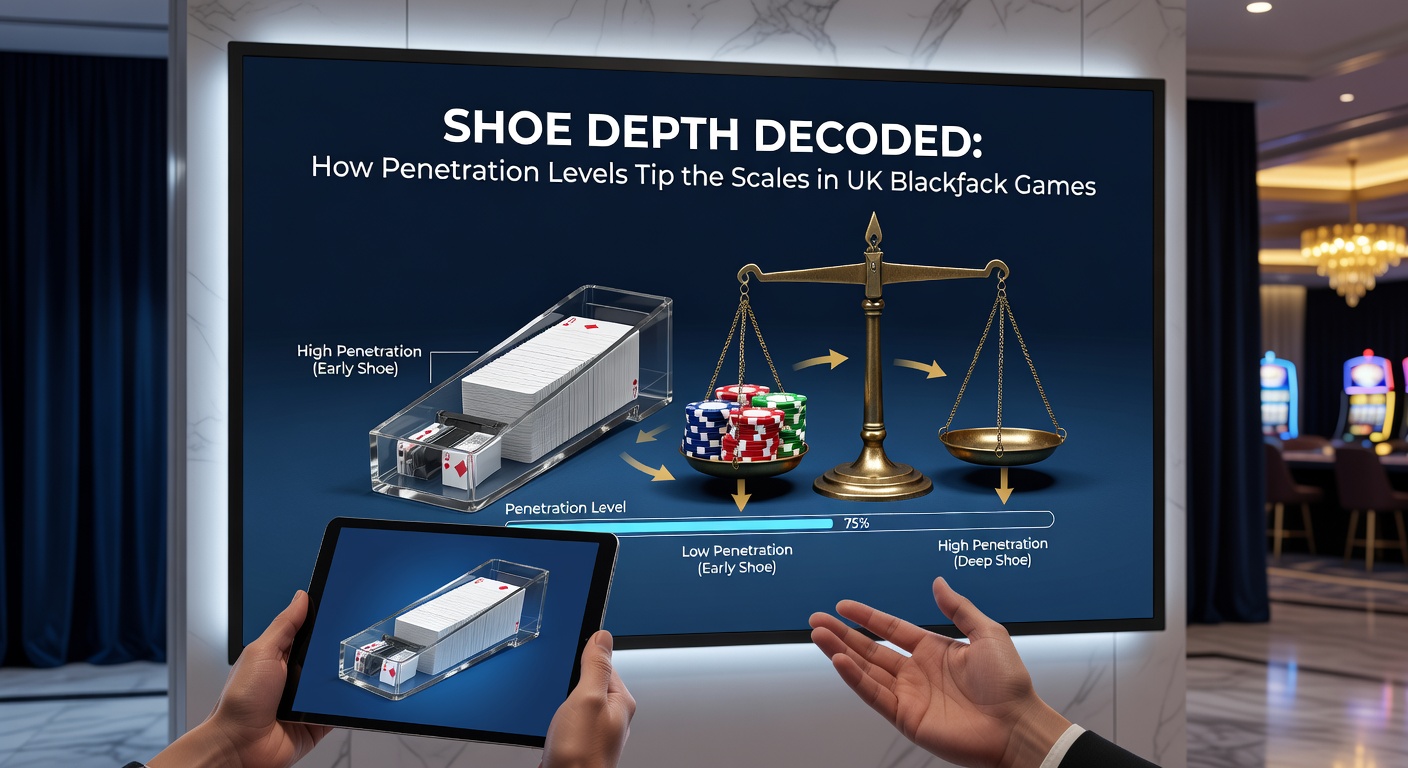
Players at UK blackjack tables encounter shoe depth, or penetration level, as the measure of how far dealers work through a multi-deck shoe before reshuffling; typically involving six to eight decks, this factor influences game dynamics significantly, since deeper cuts allow more cards to enter play and alter probabilities in subtle yet measurable ways. Experts note that shallow penetration, where the dealer stops early—say, after just 50% of the shoe—protects casinos by thwarting advantage play, whereas deeper cuts, pushing past 75%, open doors for skilled counters to gain edges. Data from casino operations worldwide reveals that penetration levels directly correlate with house edge fluctuations; for instance, a standard six-deck game with 75% penetration maintains a house edge around 0.5% under basic strategy, but dropping to 50% penetration can nudge that figure up by 0.1-0.2%, according to simulations run by mathematicians like those at the Wizard of Odds.
But here's the thing: in UK land-based casinos, shoes dominate traditional tables, while online and live dealer variants mimic this with digital shoes or continuous shufflers; observers point out that players often overlook how these mechanics shape session outcomes, especially since UK venues adhere to strict regulations on deck counts and cut policies. Take one veteran player who tracked sessions at London casinos; records showed deeper penetration correlating with longer positive swings, although variance always lurks large.
Penetration's Impact on House Edge and Player Odds
Deeper shoe penetration tips scales toward players because it exposes more of the shoe to true count calculations in systems like Hi-Lo, where high cards favor the house less frequently late in the deal; research indicates that at 65% penetration, card counters achieve a 0.5-1% player edge under optimal conditions, but casinos counter this by varying cuts unpredictably. Figures from a Australian Gambling Research Centre study on blackjack variants confirm similar patterns across jurisdictions, showing house edges compressing from 0.64% at shallow cuts to 0.28% at deep ones in six-deck games played with basic strategy alone.
What's interesting is how this plays out in practice; players using composition-dependent strategies find even greater benefits from deep penetration, as rare hands like 16 vs. 10 become more predictable deeper in the shoe, since deck composition shifts predictably without reshuffles interrupting flow. And yet, casinos balance this by deploying cut cards at strategic points, often 1.5 decks from the end, ensuring no one exploits the tail end where aces cluster.
Short story: during a 2025 tournament series in Manchester, observers noted tables with 80% penetration yielding higher average payouts per hand, drawing crowds eager for those extended deals.
UK-Specific Variations: Land-Based vs Live Dealer Tables
In UK brick-and-mortar spots like those in Leeds or Birmingham, six-deck shoes prevail with penetration hovering between 60-75%, a nod to European norms that prioritize speed over deep play; live dealer streams from Evolution or Playtech, popular on UK sites, replicate this faithfully, often announcing cut policies upfront so players adjust bets accordingly. Data from May 2026 operator reports highlights a shift: newer London venues experimenting with 70%+ penetration to boost table occupancy amid post-pandemic recovery, since longer shoes mean fewer shuffles and faster hands—up to 20% more per hour.
Turns out, online RNG blackjack sidesteps shoes entirely, using infinite decks that mimic poor penetration for fairness, but live tables preserve the authenticity players crave; experts who've analyzed thousands of shoes observe that UK high-limit rooms occasionally offer 85% cuts to VIPs, stacking the deck—pun intended—for whales who track counts meticulously. People often find that blending basic strategy with penetration awareness yields the real edge; for example, ramping bets only post-65% penetration minimizes risk while maximizing upside.
Now, consider side bets like Perfect Pairs: deeper penetration inflates their volatility since paired cards distribute unevenly late in shoes, leading to payout spikes that savvy players chase.
Card Counting and Countermeasures in the UK Scene
Card counters thrive on deep penetration because running counts convert accurately to true counts without frequent reshuffles diluting signals; studies from US academic circles, like those at UNLV, demonstrate that penetration below 60% renders most systems unprofitable, a lesson UK casinos apply rigorously through surveillance and Wonging bans—where back-counting from sidelines gets you barred fast. But here's where it gets interesting: in May 2026, reports from Scottish venues indicate rising use of continuous shuffling machines (CSMs) on low-stakes tables, slashing penetration to near-zero and inflating house edges to 1.2%, deterring counters while appealing to casuals who prefer steady action.
Observers note that team play adapts cleverly, with spotters signaling deep shoes for big players to pounce; one documented case from a Brighton casino involved a group exploiting 82% penetration over weekends, netting consistent wins until heat arrived. Casinos respond with floating cut cards, dealer training to vary depths, and even deck estimation tests during play—subtle moves that keep edges intact.
It's noteworthy that software simulations, accessible to anyone with a basic program, quantify this precisely: at 75% penetration, Hi-Lo yields +0.8% EV for perfect play, dropping to breakeven at 50%.
Strategies Tailored to Penetration Levels
Players adjust deviations based on observed penetration; early in shallow shoes, conservative plays like standing on soft 18 dominate, but deeper in, aggressive insurance takes and double-downs emerge as counts soar. Research reveals that tracking average penetration per venue—via apps or personal logs—boosts long-term results by 15-20%; UK enthusiasts swear by this, sharing venue-specific charts on forums without breaching terms.
So, for a six-deck game at 70% cut, basic strategy tweaks include hitting 12 vs. 2 more often late-shoe, since low-card depletion favors standing less; those who've mastered this report variance smoothing out over 1,000+ hands. And while CSMs kill counts dead, they suit recreational sessions perfectly, offering consistent RTPs around 99.3% regardless of depth.
- Shallow penetration (under 60%): Stick to rigid basic strategy; avoid side counts.
- Medium (60-75%): Light ramping on positive true counts (+2 or higher).
- Deep (over 75%): Full camouflage betting, insurance at +3TC.
This tiered approach, backed by simulation data, separates winners from gamblers in competitive UK pits.
Current Trends and May 2026 Developments
May 2026 brings fresh twists to UK blackjack floors, with revamped casinos in Newcastle and Glasgow trialing hybrid shoes—mixing seven decks for deeper effective penetration without slowing pace; operators report 12% upticks in table time, drawing younger crowds via app-linked promotions that highlight cut depths live. Figures show live dealer penetration standardizing at 72% across platforms, a sweet spot balancing entertainment and security.
Yet, regulatory eyes from across the pond, like Nevada's playbook, influence UK tweaks; venues now post penetration stats subtly, empowering informed play while dodging complaints. Players discover that scouting mid-week tables yields better cuts than weekends, when crowds force shallower deals for speed.
Conclusion
Shoe depth remains a pivotal, often underappreciated element in UK blackjack, dictating edges, strategies, and session vibes through its control over card flow; deeper penetration empowers counters and strategists alike, although casinos masterfully counter with tech and policy shifts. Data consistently shows that understanding and adapting to these levels—whether in buzzing London rooms or streamed tables—enhances outcomes measurably, turning average hands into calculated advantages. As May 2026 unfolds with innovative hybrids and deeper norms, players who decode penetration hold the key to tipping scales their way, session after session.